
Committee declares moderate drought for all S.C. counties
The South Carolina Drought Response Committee met on April 9 to assess statewide drought conditions. The DRC is the state's major drought decision-making entity and determines drought severity as defined by the South Carolina Drought Response Act to protect the state's natural resources. The act establishes four levels of drought: incipient, moderate, severe and extreme. For more information about the DRC and the South Carolina Drought Response Program, visit scdrought.com.
During the meeting, the committee upgraded 35 counties from incipient drought to moderate drought. These counties join Abbeville, Anderson, Cherokee, Greenville, Greenwood, Laurens, McCormick, Oconee, Pickens, Spartanburg and Union counties, which were elevated to moderate drought in early March. All drought indicators supported this upgrade.
The committee received reports of record-low streamflows, increased wildfire risk and growing concern among farmers regarding current planting conditions and the outlook for the upcoming growing season.
The South Carolina State Climatology Office provided an overview of rainfall deficits. Statewide precipitation from September through March ranked as the driest in 131 years of record. Typically, South Carolina receives approximately 25 inches of rain during this period; however, only about 10 inches fell this year - just 40% of normal. The state has not experienced consistent, near-normal rainfall since August 2025.
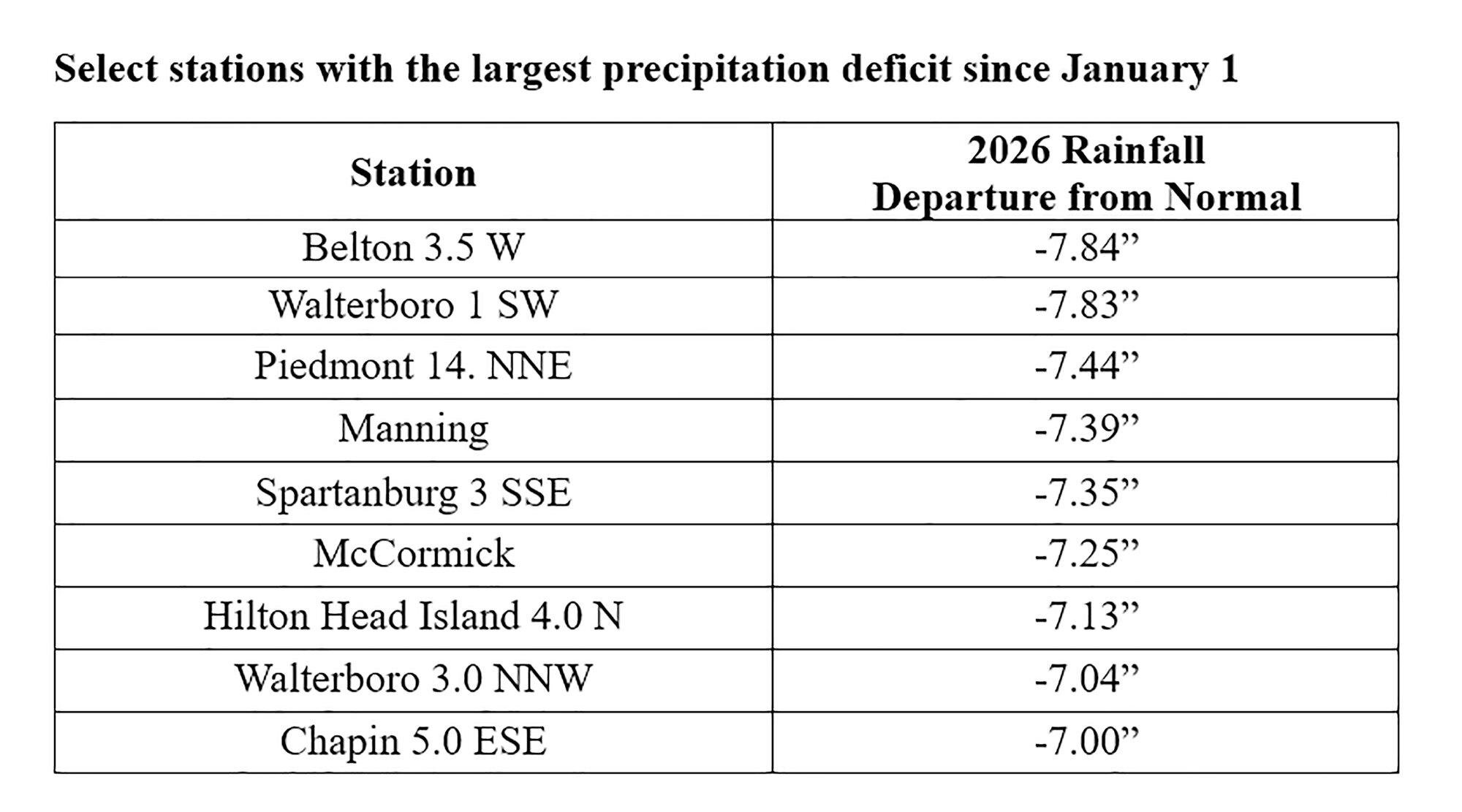
Rainfall deficits are widespread across South Carolina. Since Jan. 1, deficits of up to 7 inches have been reported from the mountains to the coast, highlighting the severity and geographic extent of the current drought conditions.
According to the South Carolina Department of Environmental Services, well-below-normal rainfall over the past month has resulted in significant declines in streamflow levels statewide. Numerous gauging sites are experiencing streamflow levels below their fifth percentile flow, with many sites reaching record-low 14-day average flows during the past several weeks. Groundwater conditions have also degraded during the last month, with most groundwater sites experiencing below-normal to well below-normal conditions. The deterioration in streamflow and groundwater conditions strongly supported upgrading the drought status level for all counties in incipient status to moderate drought status.
The state did not receive the winter rainfall that is critical for recharging our surface and groundwater. Because evaporation rates are much lower in winter, more rainfall infiltrates the ground. This recharges our surficial aquifers and typically leads to higher baseflow levels in streams. Winter groundwater recharge is important for sustaining aquifer and stream baseflow levels later in the spring and summer, especially during drier periods. Unfortunately, the much-needed recharge did not occur this past winter.
The South Carolina Forestry Commission emphasized that seasonally lower humidity, periods of stronger winds and continued drying of heavy dead fuels are elevating wildfire concerns across South Carolina, particularly in storm-impacted areas where larger fuels are beginning to actively contribute to fire behavior. KBDI values are also trending upward, signaling continued drying in lower litter and duff layers and reinforcing the increased potential for persistent smoldering, holdover heat and fires that are more resistant to control methods. These conditions increase resistance to control, prolong smoldering in duff and downed material and raise the importance of fire weather awareness and responsible burning practices statewide.
The South Carolina Forestry Commission recommends that anyone conducting outdoor burning take extra precautions. Be sure to notify the Forestry Commission before burning, establish a firebreak around your fire, have the proper tools or water available to control the fire if it escapes, and remain with the fire until it is completely safe.
The committee heard numerous concerning reports from South Carolina agriculture producers, ranging from very low irrigation ponds and pastures not growing to farmers having to irrigate just to get crops to germinate. According to the South Carolina Department of Agriculture, producers are utilizing irrigation not only for crop emergence, but also to maintain crops. Livestock forages in all aspects are stunted and are behind a normal standard for this time of year. Any surface water used for irrigation is on the cusp of drying to a point of non-use, and rain is desperately needed to return to a normal level of moisture across the state.
Thankfully some encouraging news came from South Carolina Department of Environmental Service with no water systems reporting any water quantity or water quality issues at this time. However, there are reports of a few private shallow wells going dry in the Upstate.
The Drought Response Committee will reconvene on Thursday, May 14.